
The DARPA Lift Challenge sets a historic 4:1 goal. Open engineering, steady public investment, and responsible autonomy can strengthen American technology and protect warfighters.
America stays strong when it is willing to attempt hard things before anyone else. That is why the Defense Advanced Research Projects Agency matters. DARPA does more than fund research. It gives engineers a clear problem, a high bar, and a reason to build something that ordinary markets may not support yet.
The DARPA Lift Challenge is a perfect example. It asks teams to build a vertical-lift aircraft that weighs no more than 55 pounds, carries at least 110 pounds, and completes a five-nautical-mile course. The main score is payload divided by aircraft weight. DARPA is offering $6.5 million in prizes and wants competitors to push beyond a 4:1 payload-to-weight ratio.
That target sounds like a number on a spreadsheet. It is much more than that. It is a demand for a major leap in propulsion, structure, controls, and energy use at the same time.
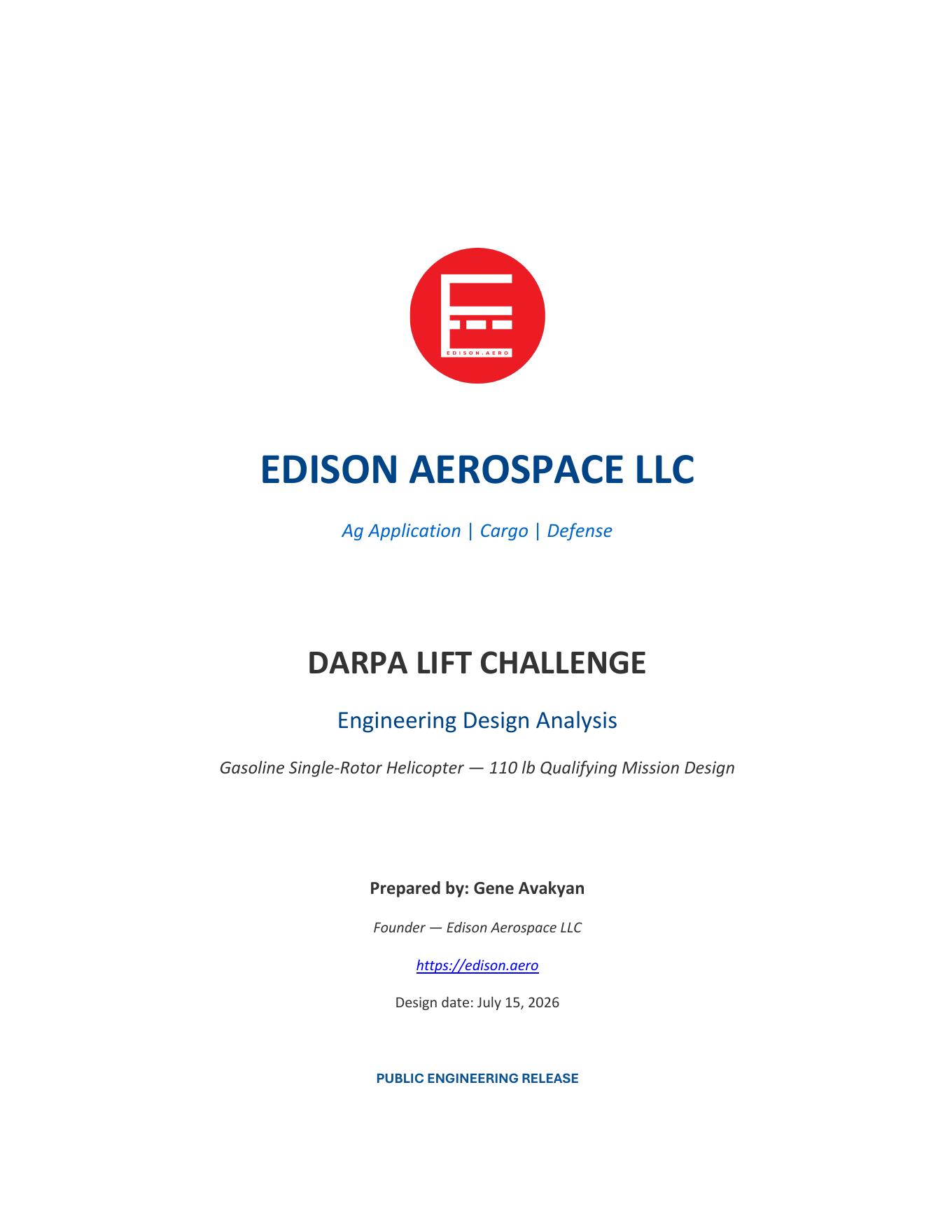
I decided Edison Aerospace could contribute even though we will not appear on the flight line. I am publishing our engineering design paper free for others to read, test, challenge, and reuse. I would rather put the work into the hands of builders than let it sit on a private drive. An idea becomes more valuable when other people can find its weak points, improve it, and carry it farther.
Free engineering paper — Edison Aerospace DARPA Lift Challenge Design

Why DARPA Is Worth the Investment
DARPA was created after Sputnik shocked the United States. Its mission is to create and prevent technological surprise. That mission has produced military advances such as stealth and precision systems, while helping create civilian technologies that now feel ordinary, including the internet, compact GPS receivers, automated speech recognition, and early work behind mRNA vaccines.
This history should settle an important political question. Advanced research is not waste simply because the result is uncertain. Uncertainty is the point. Private companies usually have to show a near-term return. DARPA can pursue a breakthrough whose full value may not appear for years.
America should spend more on that work. DARPA reports an enacted fiscal year 2026 budget of $4.322 billion and a fiscal year 2027 request of $5.039 billion. Congress should fully fund that request and build steady growth around it. We should also expand challenge prizes, small-business research, test facilities, and fast paths from a proven prototype to a fielded system.
The cost of technology leadership is visible in a budget. The cost of technology surprise arrives later, in lost time, lost leverage, and sometimes lost lives. I prefer the first bill.
Why a 4:1 Payload Ratio Is Almost Unheard Of
Payload-to-weight ratio answers a simple question: how much useful load can an aircraft carry compared with what the aircraft itself weighs, including its power source? At 4:1, a 25-pound aircraft carries 100 pounds. The payload is four times the machine that lifts it.
That is extraordinary for a practical, self-powered vertical-lift aircraft. DARPA says current multirotor drones are typically at 1:1 or less. A modern DJI FlyCart 30 weighs 65 kilograms with two batteries and carries 30 kilograms in that configuration, about 0.46:1. The purpose-built Kaman K-MAX helicopter has a 5,145-pound empty weight and a 6,000-pound cargo-hook capacity, about 1.17:1.
Those are not weak aircraft. They are useful machines built around real limits. Vertical flight requires continuous power just to stay in the air. Motors, engines, fuel, batteries, rotors, transmissions, controls, and structure all count against payload. Every pound added to make the aircraft stronger becomes another pound the lifting system must carry.
That is why 4:1 is not a routine product requirement. It is a forcing function. It pushes teams to question familiar layouts, use materials carefully, cut unnecessary mass, and prove that every part earns its place. Even a design that falls short can produce better rotors, lighter structures, safer controls, and more efficient power systems for the next generation of American aircraft.
What I Am Publishing
The Edison Aerospace paper describes a gasoline-powered, single-rotor helicopter concept sized around the Challenge mission. The current analysis estimates an aircraft weight of 26.76 pounds including fuel, which gives a plate-only score of about 4.11:1 with a 110-pound payload. It models the actual repeated-lap course and sets qualification gates for power, fuel use, controls, vibration, payload handling, and full-lane flight.
I want to be clear about what that means. This is an engineering analysis, not a claim of a completed flight. The design is not mission-capable until hardware tests and a full course demonstration confirm the assumptions. Publishing the paper lets others inspect both the promising parts and the remaining risks.
Open engineering is one way a small American company can serve the larger industrial base. A student team may reuse a method. A supplier may spot a lighter component. Another designer may reject our configuration but keep a useful calculation. All of those outcomes move the field forward.
Edison Aerospace Is Working in Two Worlds
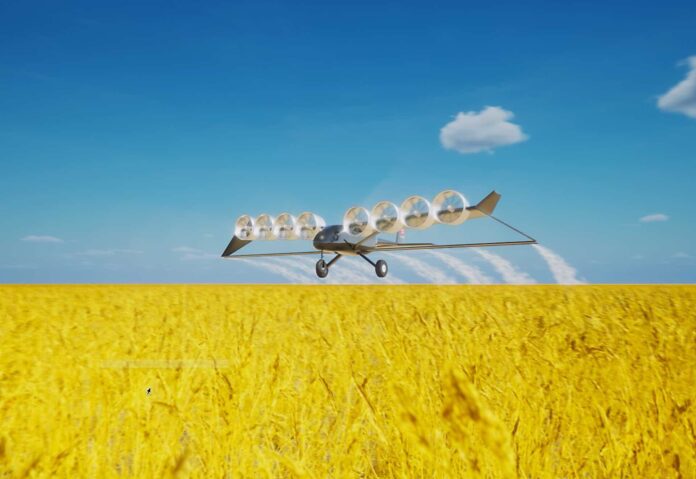
At Edison Aerospace, our work begins with agriculture. Heavy 1 is our distributed-electric, short-takeoff-and-landing aircraft concept for crop spraying. The design uses eight electric motors, a 40-foot wingspan, and a 200-gallon spray capacity, with the goal of operating from short, unprepared fields. We are also developing a cargo version for remote delivery, medical supplies, humanitarian support, and commercial logistics.
Agricultural aviation and defense may look far apart. In engineering terms, they share hard problems: carrying a useful load, operating away from major airports, controlling cost, and reducing risk to people. A system that can move liquid over a farm can teach lessons about moving supplies in a contested area.
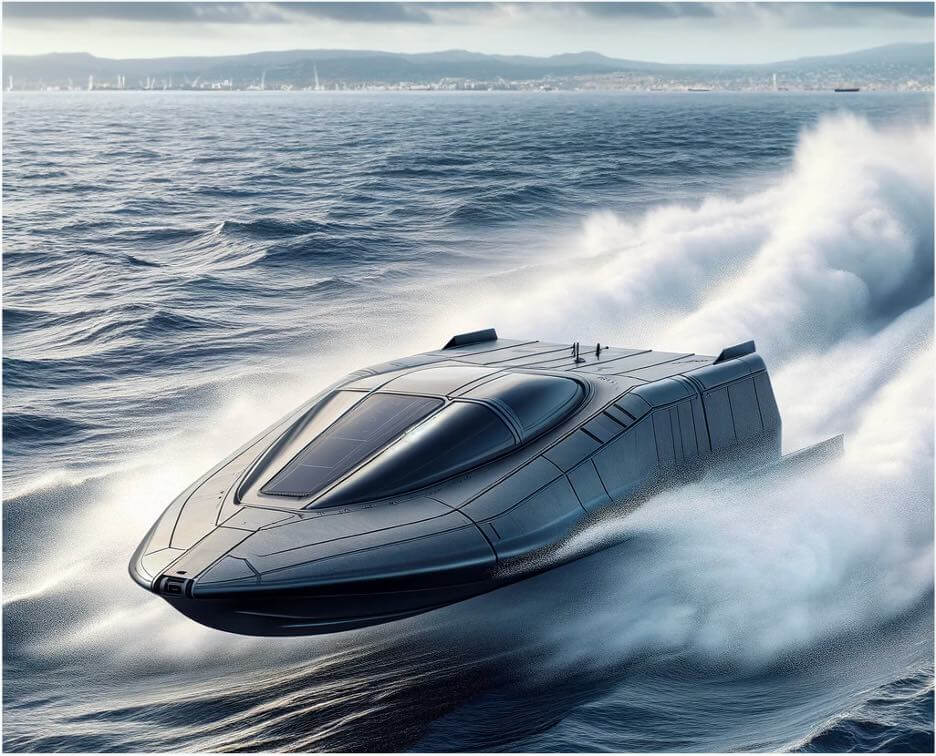
Our defense concepts extend that same thinking into unmanned cargo delivery, aerial decoys and electronic support, maritime sensing, and autonomous surface vessels. Edison’s portfolio includes Heavy 1 Defense, LionFish, SeaWatch, the UNCV unmanned naval concept, and a mobile power and command hub. These are development projects and concepts, not claims that every system is fielded today. The purpose is to build common technology that can serve civilian and national-security missions.
Use Robots for the Dangerous Work
The political case for autonomy should start with people. If a robot can carry supplies through a threatened corridor, inspect a mine, watch a dangerous coastline, or act as a decoy, then a service member may not have to do that job in the same exposed place.
That does not mean removing human responsibility. The Defense Department’s autonomy policy calls for appropriate human judgment over the use of force, lawful operation, realistic testing, reliability, and safety. That is the right standard. We should move people away from danger while keeping people accountable for decisions.
Robotics will not remove risk from war. It can reduce unnecessary exposure. It can give commanders more information, sustain units over the last mile, and let scarce crews focus on work that truly requires human judgment. When American objectives require action, our technology should help achieve them with the fewest possible Americans in harm’s way.
A Political Choice About the Future
The United States cannot assume it will remain the world’s technology leader. Leadership has to be renewed through laboratories, factories, test ranges, skilled workers, patient capital, and public programs willing to take a real risk.
DARPA is one of the best tools we have for doing that. The Lift Challenge invites universities, companies, and garage inventors to attack a problem with military and civilian value. It creates a national contest around measurable performance, then lets many different ideas compete.
My contribution is the Edison Aerospace design paper. I am making it available free for reuse because American engineering advances faster when useful work is visible. I hope readers will test it, criticize it, improve it, and build beyond it.
Congress should give DARPA more room to make bold bets, and the country should demand disciplined testing in return. That is a fair bargain: public investment, hard evidence, open competition, and a clear national purpose.
America did not reach the top of the technology ladder by waiting for certainty. We got there by funding difficult work, learning from failure, and giving capable people a chance to prove what was possible. We should do more of that now.
References
- DARPA, Lift Challenge program page and Challenge details.
- DARPA, About DARPA.
- DJI, FlyCart 30 specifications.
- Kaman Corporation, K-MAX specifications.
- Edison Aerospace, company overview and defense portfolio.
- U.S. Department of Defense, update to Directive 3000.09, Autonomy in Weapon Systems.
Gene Avakyan is the founder of Edison Aerospace. He holds a B.S. in Aerospace Engineering from UCLA and an MBA from Pepperdine University, and has three decades of technical leadership experience spanning aerospace, public systems, and emerging technology.