
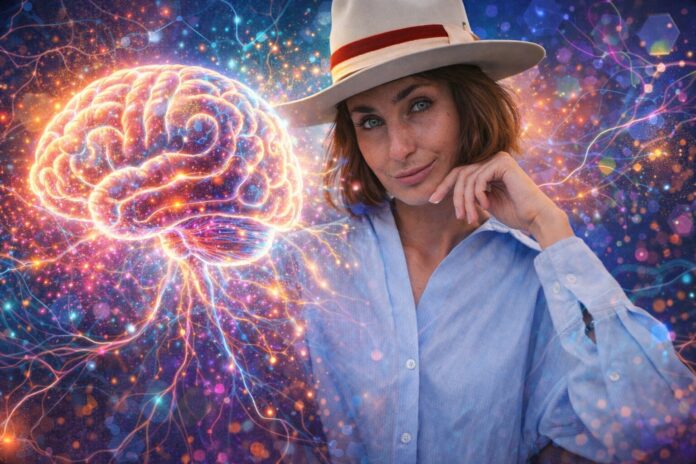
Neuroaesthetics explains what happens in the brain when we look at art — from dopamine release and mirror neurons to the science of aesthetic intelligence.
People approach a painting, pause for a few seconds, and either move on or remain standing. Sometimes they smile. Sometimes they frown. Sometimes they return again.
From the outside, it looks like ordinary viewing of art. But inside the brain, at that moment, one of the most complex perceptual processes a human is capable of is taking place.
Neuroaesthetics—the field of science that studies how the brain responds to beauty—shows that when we look at a work of art, not just one brain region becomes active, but an entire network of systems. And it all begins much earlier than we consciously realize.
When a person looks at a painting, the visual cortex is the first to activate. It immediately begins recognizing shapes, lines, colors, and contrast. But almost instantly another system joins in: the emotional system.
The brain does not simply analyze the image. It asks a question: “What do I feel?”
That is why two different paintings can evoke completely different reactions in a viewer—from delight to inner tension. Neuroaesthetic research shows that during this moment the brain’s reward system becomes particularly active—the same structures that respond to love, music, or delicious food. When we perceive harmony, the brain literally releases dopamine. That is why beauty can feel almost physical.
But there is another mechanism at work.
The brain is constantly trying to predict the world. It searches for patterns, structures, and meaning. If a painting is too simple, the brain quickly “solves” it and loses interest. If it is too chaotic, the brain cannot find structure and also disengages.
But when a work balances between order and mystery, something interesting happens.
The brain enters a kind of game.
And it is precisely at this point that the feeling we call aesthetic pleasure is born.
There is another remarkable feature.
People often say, “I can’t explain why this painting moves me.” And that is true. Because our response to art often arises before rational thinking begins.
At that moment, what are known as mirror neurons are at work—a brain system that allows us to feel the movements and emotions of others. When we look at the brushstrokes of an artist, the movement of a figure in a painting, or the tension of a composition, the brain literally simulates this state within the body.
We are not simply looking at a painting.
We are experiencing it.
That is why art has always played a special role in culture.
It trains one of the rarest human abilities—the ability to perceive complexity.
Aesthetic intelligence is a skill that allows a person to perceive the world through nuances of form, atmosphere, and sensation. It is not merely taste. It is a way of thinking.
People with developed aesthetic perception are better at noticing details, sensing context, and detecting the subtle signals of their environment. That is why art is so often connected to innovation, creativity, and cultural influence.
In a world where information moves faster and faster, museums remain one of the few spaces where time almost stops.
A person stands before a painting, and for a few seconds the brain works differently. It stops scanning news, notifications, and tasks. It begins to contemplate.
And perhaps that is where the most important thing happens.
We think we are looking at art. But in reality, at that moment, art is reshaping the way our brain works.