
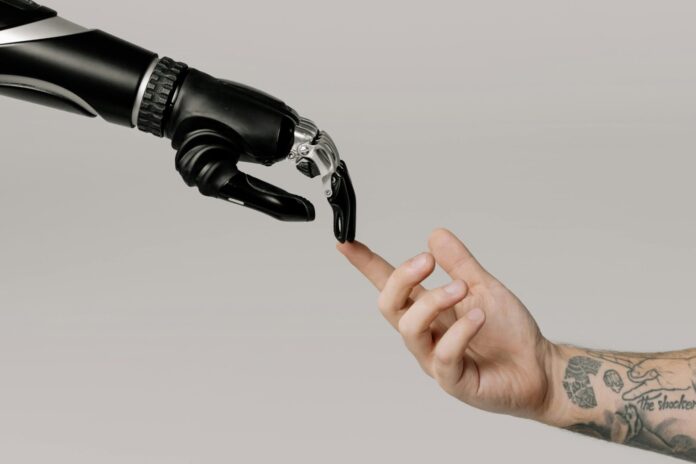
In November 2024, Coca-Cola dropped a Christmas ad made by artificial intelligence. The internet ate it alive. Critics called it “soulless.” “Dystopian.” “Devoid of any actual creativity.” The brand whose tagline is “Real Magic” had just released a thirty-second clip with no real anything in it — no actors, no trucks, no human beings making decisions about which snowflake should fall where.1
Then Coca-Cola did it again in 2025. Better animation, fewer creepy human faces, same backlash.2
Here’s what nobody at Coke needed a focus group to figure out: people are uneasy. They flinch when they realize a machine made the thing that moved them. And that flinch is not stupid. It’s old, it’s human, and it deserves a serious answer.
But the people running the loudest version of that flinch — the artists threatening to quit, the executives banning the tools, the columnists writing eulogies for human creativity — are about to learn something painful.
The flinch will not save them. It never has.
We’ve Been Here Before. We Always Lose.
Pull up a chair. About 2,400 years ago, a guy named Plato wrote down a warning from his teacher Socrates. The terrifying new technology that was going to rot the human mind? Writing. The alphabet. Books.
In Plato’s dialogue Phaedrus, Socrates tells a story about an Egyptian god who invents writing and brings it to the king as a gift. The king is unimpressed. He warns that writing will “create forgetfulness in the learners’ souls, because they will not use their memories; they will trust to the external written characters and not remember of themselves.” People will look smart, the king says, but they’ll actually be empty. “Hearers of many things and will have learned nothing.”3
Read that quote again and tell me it doesn’t sound exactly like every op-ed about ChatGPT written in the last two years.
The father of Western philosophy was scared of the book. And the book went on to carry essentially every important idea humans ever had — including Plato’s own warning against it. The irony writes itself. Literally.
Jump forward to 1935. A German thinker named Walter Benjamin watches photography and film flood the world and writes one of the most famous essays in modern thought: “The Work of Art in the Age of Mechanical Reproduction.” His argument is that real art has an “aura” — a kind of magic that comes from it being one thing, made once, existing in one place. Cameras kill that. When a painting can be reproduced a million times on postcards, the original loses its sacred status.4
Benjamin watched this with mixed feelings. But here is the part most people skip: he did not conclude that art was dead. He saw that killing the aura also broke the velvet rope. Suddenly regular people could see, own, and make images that used to belong only to kings and cathedrals. The loss was also a door opening.5
Plato feared the book. Benjamin watched cameras kill the aura. We are watching AI do it again — bigger, faster, weirder. We are not the first humans to stand at this exact cliff. We are just the latest. And every previous generation that drew a line in the sand and shouted “the machines will never cross this” watched the tide erase the line within twenty years.
There is a German philosopher I’ll mention only briefly because his name scares people: Martin Heidegger. He wrote in 1954 that the danger of modern technology isn’t the machines themselves. It’s that we slowly start to see everything — rivers, forests, eventually ourselves — as resources to be optimized. He called this “enframing.”6 If you’ve ever felt like a job posting was treating you like inventory, you’ve felt what Heidegger was talking about. The risk with AI isn’t that it makes art. It’s that we start to look at human creativity itself as one more inefficient process waiting to be automated.
But Heidegger also said something most people miss. Quoting an older poet, he wrote: “Where the danger is, the saving power also grows.”6 The same technology that threatens to flatten us might force us — finally — to ask what is actually, stubbornly, irreplaceably human.
The Numbers Don’t Care How You Feel
Now let’s talk about the part most opinion writers avoid. The disdain is real. The data is also real. And the data says something uncomfortable: AI is already a cheat code, and the people refusing to use it are not standing on principle. They are falling behind.
An MIT study published in 2023 found that when professional writers were given ChatGPT to help with workplace writing tasks, they finished the work 40 percent faster — and the quality of their output went up by 18 percent.7 That is not a science fiction projection. That happened. With 453 real people doing real grant-writing, real emails, real cover letters.
For software developers, the numbers are even louder. Research tracking 80 million GitHub commits found that by the end of 2024, AI tools were writing roughly 30 percent of the Python code submitted by U.S. developers.8 A massive randomized trial across Microsoft, Accenture, and a Fortune 100 company found that giving developers an AI coding assistant produced clear productivity gains — and that less experienced developers gained the most.9
Read that last part twice. The tool helps beginners more than veterans. It compresses the gap. The kid with no résumé and an internet connection can now do what used to take a decade of mentorship to learn.
This is leverage. Real leverage. And right now, while the debate rages in op-ed columns, somebody at your competitor is using these tools to do in a Tuesday afternoon what used to take your team a month.
You can refuse the tools on principle. That’s your right. But understand the trade. You are not winning a moral victory. You are choosing to bring a horse to a Formula One race because horses are more authentic.
And Yet — The Soulless Coke Ad Was Not Wrong
Here is where the honest version of this article diverges from the boosters in Silicon Valley. The flinch is not just nostalgia. It is information.
A 2024 study by NielsenIQ scanned consumer brain activity while people watched AI-generated ads. Viewers found the AI ads “annoying,” “boring,” and “confusing” compared to traditional ads. The brand suffered for it.10 In a separate experiment by Germany’s Nuremberg Institute for Market Decisions, when an ad was labeled as AI-generated, consumers rated it as less natural and less useful — even when the ad content was identical to one labeled as human-made.11
Let that sink in. Same ad. Different label. Different reaction. People are not just rejecting bad AI output. They are reacting to the idea that no human stood behind the work.
A July 2025 survey by Billion Dollar Boy of 4,000 consumers across the U.S. and U.K. found that 32 percent now say AI is negatively disrupting the creator economy — nearly double the 18 percent who said so in 2023.12 A Gartner survey released in September 2025 found that 53 percent of consumers do not trust AI-powered search results, and 61 percent want a switch to turn AI summaries off entirely.13
And Pew Research found a jaw-dropping gap between AI experts and the general public. Fifty-six percent of AI experts think AI will be good for America over the next twenty years. Only 17 percent of the public agrees.14
So this is the bind. The tools work. The leverage is real. And the audience hates it.
What do you do with that?
The Five Adjustments
This is the part nobody wants to write, because it requires letting two contradictory things be true at once. AI is too powerful to refuse. AI is also creating real psychological costs we are nowhere near ready for. The grown-up move is not picking a side. It’s making adjustments — five of them — that work whether you’re a true believer or a skeptic.
One. Stop confusing the tool with the trophy. Use AI to draft, to research, to explore, to compress the boring work. But understand that audiences increasingly want to see the human fingerprints on the final product. The future probably isn’t pure-AI content or pure-human content. It’s hybrid — where the machine does the heavy lifting and the human makes the judgment calls that matter.
Two. Disclose, or lose. The Nuremberg study showed that labeling kills engagement. But the European Union is already moving to require AI disclosure,11 and the public is demanding it. Brands that try to sneak AI past their customers are setting up a much worse betrayal later. Coca-Cola’s mistake in 2024 wasn’t using AI. It was using AI on its most emotionally protected campaign — the Christmas ad — and acting surprised when people felt insulted.15
Three. Treat human-made as the new luxury. When a thing becomes infinite, the rare version becomes valuable. Handmade furniture costs more than IKEA. Vinyl outsold CDs again last year. As AI floods the world with frictionless content, the genuinely human-made object — slow, imperfect, undeniably traceable to a real person — becomes a premium category. Smart creators are already positioning themselves there.
Four. Become a connoisseur of judgment, not consumption. When anyone can make anything, the rare skill stops being production and starts being curation, taste, and the ability to know what is actually worth your attention. The ancient Greeks called this phronesis — practical wisdom. It is about to be the most valuable thing you own. Cultivate it.
Five. Brace for the possibility that the tool surpasses the user. This is the part the AI cheerleaders don’t want to say out loud. The comfortable story — that AI will always need a human in charge — is a story we tell because we need it. The frontier of “this still requires a real person” has been retreating every year. To assume that retreat stops at your job is to repeat the mistake of every generation that drew a confident line and watched it get erased. Build skills that compound with the machine, not against it. Build relationships, reputation, and judgment — the parts that are hardest to copy.
The Mirror We Can’t Look Away From
There’s an unsettling thing AI does. By being so good, it forces us to finally answer a question we’ve been dodging for centuries: What, exactly, can a human do that a machine cannot? And when we go looking for the answer, we find we are not as sure as we thought.
That is not a disaster. That is the oldest, deepest work humans have ever done. Suddenly made urgent. Suddenly unavoidable.
The people who sneer at AI are defending a definition of “authentic” they never actually thought through. The people who cheer it blindly haven’t reckoned with what we might lose. Both are dodging the hard work. The grown-up move is to do both hard things at once — use the tool with open eyes, while doing the deeper work the tool is forcing on you.
Plato feared the book and gave us philosophy anyway. Benjamin mourned the aura and watched new art rise where it had been. We are standing in that same long line now — frightened, leveraged, and dared, one more time, to figure out how to be more deliberately human than the easy old world ever asked us to be.
The soulless Coke ad was a warning. The 40 percent productivity boost is an opportunity. The flinch is real information. The leverage is real money.
You don’t have to pick one. You have to learn to hold both — and move.
References
[1] Helmore, Edward, and Pegah Bouzari. “Coca-Cola causes controversy with AI-generated ad.” NBC News, November 18, 2024. https://www.nbcnews.com/tech/innovation/coca-cola-causes-controversy-ai-made-ad-rcna180665
[2] Allan, Graham. “Coca-Cola faces backlash again for missing the spirit of the holidays with another AI-slop ad.” TechRadar, November 2025. https://www.techradar.com/ai-platforms-assistants/coca-cola-faces-backlash-again-for-missing-the-spirit-of-the-holidays-with-another-ai-slop-ad
[3] Plato, Phaedrus, ca. 370 BCE, section 275. Translation via Perseus Digital Library, Tufts University. https://www.perseus.tufts.edu/hopper/text?doc=Perseus:text:1999.01.0174:text%3DPhaedrus:page%3D275
[4] Benjamin, Walter. “The Work of Art in the Age of Mechanical Reproduction” (1935). Translated by Harry Zohn. MIT archive. https://web.mit.edu/allanmc/www/benjamin.pdf
[5] “The Work of Art in the Age of Mechanical Reproduction.” Yale Modernism Lab. https://campuspress.yale.edu/modernismlab/the-work-of-art-in-the-age-of-mechanical-reproduction/
[6] Heidegger, Martin. “The Question Concerning Technology” (1954). English translation, University of Hawaii archive. https://www2.hawaii.edu/~freeman/courses/phil394/The%20Question%20Concerning%20Technology.pdf
[7] “Study finds ChatGPT boosts worker productivity for some writing tasks.” MIT News, July 14, 2023. https://news.mit.edu/2023/study-finds-chatgpt-boosts-worker-productivity-writing-0714
[8] Daniotti, Simone, Johannes Wachs, Xiangnan Feng, and Frank Neffke. “Who is using AI to code? Global diffusion and impact of generative AI.” Complexity Science Hub, June 2025. https://arxiv.org/pdf/2506.08945
[9] Cui, Zheyuan, Mert Demirer, Sonia Jaffe, Leon Musolff, Sida Peng, and Tobias Salz. “The Effects of Generative AI on High-Skilled Work: Evidence from Three Field Experiments with Software Developers.” MIT Economics, 2024. https://economics.mit.edu/sites/default/files/inline-files/draft_copilot_experiments.pdf
[10] NielsenIQ. “Hidden Consumer Views on AI-Generated Ads.” NIQ research, December 12, 2024. https://nielseniq.com/global/en/news-center/2024/niq-research-uncovers-hidden-consumer-attitudes-toward-ai-generated-ads/
[11] Buder, F., Hesel, N., and Heimstädt, A. “Transparency Without Trust: Consumer Attitudes Toward AI-Generated Marketing Content.” Nuremberg Institute for Market Decisions (NIM), 2024. https://www.nim.org/en/publications/detail/transparency-without-trust
[12] “Consumers are rejecting AI-generated creator content.” EMARKETER, citing Billion Dollar Boy’s “Muse Two” report, October 2025. https://www.emarketer.com/content/consumers-rejecting-ai-generated-creator-content
[13] “Gartner Survey Finds 53% of Consumers Distrust AI-Powered Search Results.” Gartner, September 3, 2025. https://www.gartner.com/en/newsroom/press-releases/2025-09-03-gartner-survey-finds-53-percent-of-consumers-distrust-ai-powered-search-results0
[14] “How the US Public and AI Experts View Artificial Intelligence.” Pew Research Center, April 3, 2025. https://www.pewresearch.org/internet/2025/04/03/how-the-us-public-and-ai-experts-view-artificial-intelligence/
[15] “‘Soulless’ AI-generated Coca-Cola Christmas ad backfires.” AIAAIC Repository, November 2024. https://www.aiaaic.org/aiaaic-repository/ai-algorithmic-and-automation-incidents/soulless-ai-generated-coca-cola-christmas-ad-backfires